The Polli Nation Project
“Nature is at a crisis point. The living creatures with whom we share the planet are being decimated by our actions. We are clearing their habitat, changing the climate, poisoning them with chemicals and moving them around the globe for that some become invasive species that threaten others. We may feel powerless to challenge these global trends, but we are not. We want to show how by starting in our own gardens, we can begin to make a difference.”
~ ‘Inviting Nature to Dinner’ by Helen Schwencke & Dick Copeman
What we do
The Polli Nation Project is an inspired initiative that aims to gently reconnect you back to nature while empowering you to implement and bring to life (in stages), an organic Australian native plant-focused and biodiversity-oriented garden. It will be a garden that nourishes you in so many ways, but also one that provides ecological services to our native wildlife and pollinators.
We will specifically create a pollinator garden design unique to your site
A design that meets your garden vision while following our informed gentle and organic principles.
The design will include detailed information on the planting plan and recommended plant selection, soft landscape features, soil preparation and best ongoing practices to be followed by the ‘Habitat Gardener‘~ that’d be you!
Everything will be explained in detail and made easy for you to follow step by step.
I work in collaboration with Ashley Nicholson (Gentle by Nature), a registered Landscape Architect specialised in garden planting design. We share the approach of organic and biodynamic gardening practices based on real-world insights drawn from our own experiences and areas of expertise, while considering factors such as climate adaptability, biodiversity, water conservation and habitat creation.
Together, we will explore how a thoughtful, native-led garden could elevate your life – enhancing aesthetic, resilience, sustainability, health, functional appeal and ecological value.
You will get to implement a garden that offers:
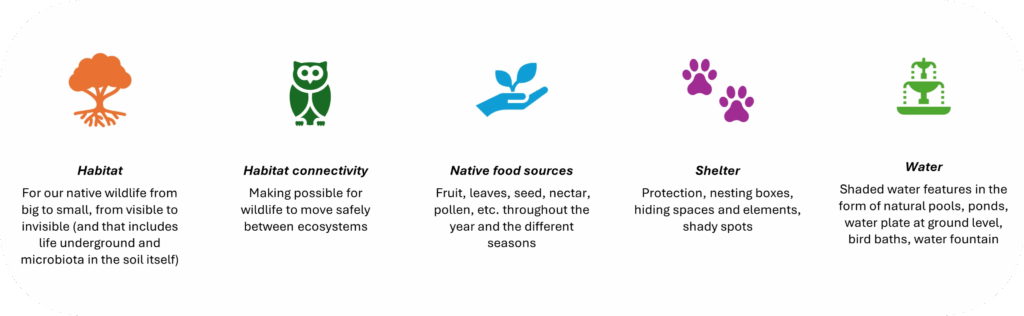
Our Values & Vision
We are building a movement that supports the protection of our pollinators and wildlife through inspired and ecologically informed garden designs, practices, education, creative storytelling and collaboration.
We work towards raising awareness & consciousness by designing gardens not only for the vital pollinators, but for other invertebrates & wildlife, whose survival is deeply tied to the health of our ecosystems.
From hosting educational workshops to eco-walks and talks, everything we do is rooted in respect for the existing, the pollinators, the land, the water, the air and the people.
Info for our Industry Partners
Our commercial services are tailored to support the construction and development sectors in meeting environmental, social and governance (ESG) obligations, enhancing sustainability credentials, and leaving a positive ecological and cultural legacy.
United Nations 17 sustainable development goals (our ethos)
Help us Save our Pollinators!
We’d love to hear from you about ways we could work together.
FAQ's
What is pollination and why is important?
Unlike animals, plants can’t move around in search of a mate, to reproduce. Therefore, most plants need pollinators to transfer the male sex cells (pollen) to the female reproductive parts of flowers. This process is called pollination, and it leads to fertilization. Good fertilisation helps plants develop seeds and fruit that feed countless animals in the world, including us.
Reference: Australianpollinatorweek
Why does biodiversity matters?
Pollinators drive biodiversity, and globally, nearly 90 percent of wild flowering plant species depend, at least in part, on the transfer of pollen by animals (IPBES, 2016).
Over 75% of the world’s food crops (by type) rely on animal pollinators for yield and/or quality and these crops contribute 35% of global crop volume and represent an estimated market value of AUS$350-$860 billion (IPBES, 2016).
Pollinators provide essential ecosystem services in the natural landscapes as well as within agricultural/horticultural and urban environments.
Reference: Australianpollinatorweek
Ecosystem services provided by pollinators?
The ecosystem services provided by pollinators extend well beyond food provisioning. Because pollination drives biodiversity, pollinators also contribute to:
Supporting services: Nutrient recycling, Soil formation, Primary production
Provisioning services: Food, Fresh water, Wood and fibre
Regulating services: Climate regulation, Flood regulation, Disease regulation, Water purification
Cultural services: Aesthetic, Spiritual, Educational, Recreational
Reference: Australianpollinatorweek
Who are the pollinators?
The vast majority of pollinator species are wild, including more than 20,000 species of bees, some flies, butterflies, moths, wasps, beetles, thrips, birds, bats and other vertebrates.
Honey bees (Apis mellifera) are particularly important as pollinators of food crops. They are the most widespread managed pollinator in the world.
Although the relative contribution of each pollinator varies significantly according to crop and location, crop yields and/or quality depend on both the diversity and abundance of pollinators and pollinator diversity contributes to crop pollination even when managed species (i.e. honey bees) are in high abundance.
Reference: Australianpollinatorweek
Are pollinators in decline?
Multiple reports globally have documented widespread pollinator decline:
Hallmann et al (2017) documented a drastic reduction over 75% in insect biomass in a 27-year longitudinal study across 63 protected areas (nature reserves) in Germany
Lister & Garcia (2018) measured arthropod biomass and documented declines over 30 years between 10-60 times
Kopec and Burd (2017) reported that of native bee species in North America and Hawaii with sufficient data to assess (1,437) more than half (749) were declining and nearly one quarter (347) were imperilled and at increasing risk of extinction. This applies to bumblebees as well as native bees.
Global data from United Nations however suggests that overall, between 1961 and 2017, there has been an 85% increase in the global population of managed honey bees. Regions where the largest population declines have been recorded are North America (-43%), Europe (-11%), and Central America (-2%) (Karasinski, 2019)
In Australia, honey bees are so far not experiencing the kinds of losses experienced in other countries. In terms of native bees and other insect pollinators however, there is insufficient data to know conclusively what is happening, mainly because there is a scarcity of research on Australian pollinators. Anecdotal evidence suggests there may be pollinator decline here too. (How often do you clean your windscreen these days compared with 30 years ago? How often do you see butterflies relative to when you were a child?)
The lack of information in Australia highlights the urgent need for further research that monitors pollinator diversity and numbers over time. Getting involved in citizen science projects that help monitor pollinator numbers over time help to build the body of evidence needed to understand what is going on.
Reference: Australianpollinatorweek
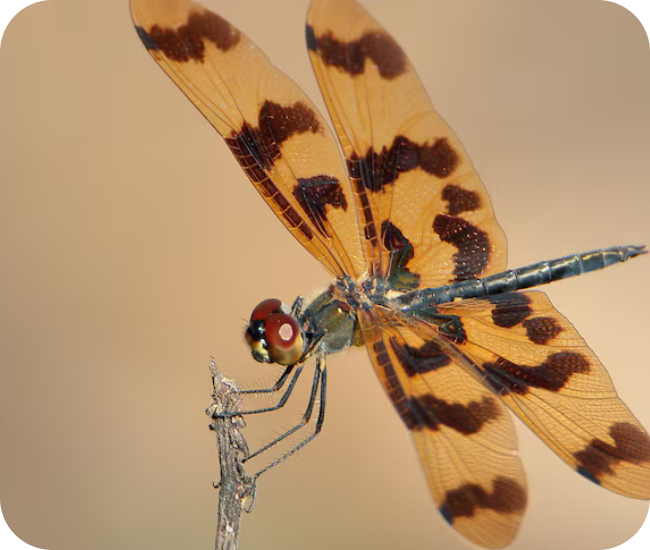
The graphic flutterer dragonfly
(Rhyothemis graphiptera)
ABC 2025 Australian Insect of the Year
(iNaturalist: G. Winterflood/CC BY-SA)